
How to Produce More Breast Milk Naturally
By Teddyy Editorial Team | Last Updated: April 25, 2026

Learning how to produce more breast milk is one of the top concerns for new mothers. If you are wondering how to produce more breast milk, the good news is that there are many natural and effective strategies. This comprehensive guide covers everything you need to know about how to produce more breast milk and ensure your baby gets adequate nutrition.
Lactation consultants emphasize that understanding how to produce more breast milk starts with establishing a good latch and frequent feeding schedule.
The principle of supply and demand is fundamental: the more your baby nurses, the more your body learns how to produce more breast milk. Pumping between feeds can also signal your body to increase production.
As a new mother, one of the most rewarding experiences you can have is breastfeeding your baby. Breast milk is quite the superfood and breastfeeding provides plenty of benefits for both your little one and you.
However, many new mothers worry that they may not be producing enough breast milk for their baby’s growth and developmental needs, because after all, it’s not easy to track your milk production or your baby’s intake. Some mothers may want to increase their milk production if they’ve been using formula milk a lot and the production has decreased.
In situations such as these, there are several effective ways to increase your breast milk production. Keep reading to discover these tips and strategies and learn how to ensure your baby is getting enough milk.
What are The Reasons for Low Milk Production
Before we explore the reasons, exactly when do you start producing milk? Amazingly, your body starts to prepare for breastfeeding as early as the third month of pregnancy and by the fourth to sixth month, your body is capable of breastfeeding!
Once your baby is born, a hormone called prolactin signals milk production. As your baby nurses, your prolactin levels increase and your breasts produce milk in a continuous ‘supply and demand’ cycle – each time milk is drained from your breasts, either through your baby feeding or through expressing (demand), your body responds by producing more milk (supply).
When your body doesn’t get enough demand for breast milk, then the production is naturally lowered. Here are the common reasons behind low milk production:
- Introducing your baby to formula milk
- Stretching out the time between feedings
- Short feeding sessions (newborns must be nursed 10-15 minutes on each side)
- Introducing pacifiers to your baby
There are also some medical conditions that may reduce the production of breastmilk, such as:
- Too much blood loss during childbirth
- Retained fragments of the placenta in the womb
- High blood pressure and/or chronic stress
- History of polycystic ovary syndrome (PCOS), diabetes, or thyroid disorders
- Obesity
- Previous breast surgeries
- Lack of sleep and nutrition
If any of these conditions apply to you, then see your doctor and they can redirect you to a lactation consultant or breastfeeding specialist.
How to Produce More Breast Milk
Here are seven tips and home remedies to increase the production of breastmilk:
Breastfeed Often
The first step to achieving the healthiest breast milk supply is to increase breast stimulation. Try to breastfeed every 2-4 hours around the clock. The more frequently and for longer durations your baby feeds at your breasts, the more milk you’ll produce.
If you’re having trouble finding a breastfeeding position that works for you, you can read our blog on ‘Breastfeeding Positions You and Your Baby Will Love.’ Even experienced mothers can teach you proper breastfeeding techniques or you can a see lactation consultant.
Breastfeed from Both Sides
Offering both breasts at each feeding provides stimulation to both breasts and increases your chances of producing more breast milk.
Try Breast Compression
When the breast milk flow slows down and your baby isn’t getting breast milk as they suck, breast compression can help you get more milk out of the breast. This technique involves manually massaging and compressing your breast with your hands.
However, do not use this technique when your baby is actively feeding as you don’t want to express more milk that your baby can handle.
Avoid Artificial Nipples as Much as Possible
Items like bottles and pacifiers can cause nipple confusion, or difficulty in switching between a breast and a bottle easily. Time spent sucking on artificial nipples can also reduce the amount of time your baby spends sucking on the breasts.
Eat a Nutritious Diet
Your body requires proper nutrition to produce milk. When mothers go on rigorous dieting, depriving themselves of essential nutrients in an attempt to regain their pre-pregnancy body quicker, it can negatively affect their breast milk supply and postpartum recovery.
Instead, eat a balanced diet heavy on fruits, vegetables, whole grains; and foods rich in iron, omega-3s, and proteins.
Likewise, keep yourself well-hydrated; you can’t produce more breast milk if you’re dehydrated.
Use a Breast Pump
Also read: how much and how often to breastfeed your baby.
Pumping milk between feedings can increase your milk supply. Many mothers worry that doing so may not leave enough milk for their baby, but your body will simply produce more.
Try Herbal Remedies
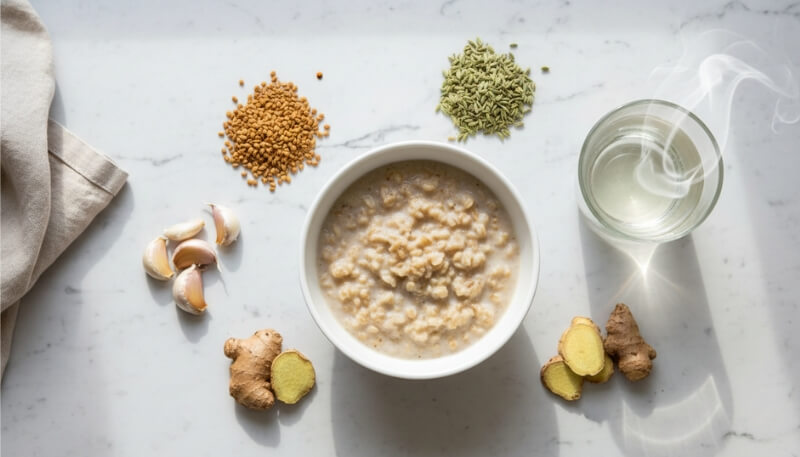
While there aren’t many scientific backings behind these herbal remedies, many mothers report overwhelmingly positive results from using them. Some of the herbal remedies that are believed to increase milk supply include ingestion of the floowing items in some form:
- Fenugreek
- Fennel
- Ginger
- Garlic
- Stinging nettle
Before starting any supplement or medication, be sure to let your doctor know and take their advice.
Foods That Help Boost Breast Milk — Galactagogues Explained
Galactagogues are natural foods and herbs traditionally used to support breast milk production. Adding iron-rich whole grains like oats and barley, protein-packed lentils and chickpeas, leafy greens like spinach and methi, and calcium-rich nuts like almonds and sesame seeds to your daily diet can meaningfully support lactation. Traditional Indian herbs such as shatavari, fenugreek (methi), moringa, and saunf (fennel) have been trusted by nursing mothers for generations — and can be consumed as teas, in curries, or as supplements after consulting your doctor.
Pumping Schedule to Increase & Maintain Breast Milk Supply
Breast milk works on a supply-and-demand system — the more consistently you nurse or pump, the more milk your body produces. Use this schedule as a starting guide and adjust based on your baby’s needs and your lactation consultant’s advice.
| Baby’s Stage | Pumping Frequency | Session Duration | Best Times to Pump | Expected Output |
| Newborn (0–4 weeks) | 8–12 times/day | 15–20 min/session | Every 2–3 hours including once at night (2–4 AM — prolactin peaks) | 15–30 ml per session |
| Tip: In the first days, hand-expression after pumping can help stimulate colostrum production. | ||||
| 1–3 Months | 6–8 times/day | 15–20 min/session | Morning (supply is highest), after nursing, and once at night | 60–120 ml per session |
| Tip: Power pumping once a day (20 min on, 10 off, 10 on, 10 off, 20 on) mimics cluster feeding and can boost supply. | ||||
| 3–6 Months | 4–6 times/day | 15–20 min/session | After morning feed, midday, after afternoon feed, before bed | 90–150 ml per session |
| Tip: Double-pumping (both breasts simultaneously) cuts time by half and increases output by up to 18%. | ||||
Common Breastfeeding Myths — Busted
Many common breastfeeding worries are based on myths that can unnecessarily stress new mothers — and stress itself reduces milk supply. Breast size does not determine how much milk you produce, soft breasts simply mean your supply has matured and regulated, and low pump output does not reflect your actual milk supply since babies feed far more efficiently than any pump. Cluster feeding, breastfeeding during a common cold, and going dairy-free are all completely safe — your body is designed to nourish your baby, and with the right support, most mothers can produce all the milk their baby needs.
How do you know that your baby is getting enough milk
Even though it’s difficult to keep track of your milk supply, there are a number of signs to look for to find out if your baby is getting enough breast milk.
- Your baby poops at least 3 to 4 times a day by the time they’re 5 to 7 days old.
- Your baby wets their diaper at least 6 times a day. Teddyy Diapers and a comfortable diaper changing mat can make this part of parenting more manageable.
- Their pee is light yellow or colourless.
- They look satisfied after feedings.
- They are steadily gaining weight.
Breastfeeding is a unique experience for every mother and baby pair. If you ever have concerns about your milk supply or your baby’s nutrition, don’t hesitate to seek guidance from a lactation consultant or your healthcare provider. Your journey as a breastfeeding mom is worth every effort, and you and your baby deserve all the care and support in the world.
Expert Resources on Breast Milk Production
How long does it take to increase breast milk supply
Most moms see noticeable changes in milk supply within 3 to 5 days of consistent effort, though the full increase takes 2 to 3 weeks. The body responds to the demand-supply principle, so each effective breast emptying tells your body to make more for the next session. The first 6 weeks postpartum is the most responsive window because prolactin receptors are still being established. After 6 months it takes longer to boost supply, usually 4 weeks of consistent effort. If you have been trying for over 3 weeks with no improvement, it is time to rule out underlying causes like thyroid issues, retained placenta, or breast tissue insufficiency with your doctor.
How stress and sleep affect milk production
Cortisol, the stress hormone, directly suppresses oxytocin, which is needed for milk letdown. Even with adequate supply in the breast, stress can prevent milk from flowing during a feed, making your baby fussy and triggering more stress in a vicious cycle. Sleep deprivation lowers prolactin levels too, particularly when you skip the night feeds when prolactin naturally peaks. Practical fixes include short 10 minute meditation before pumping, deep belly breathing while feeding, accepting daytime help so you can nap, and keeping the night-feed environment calm with low light. Mental health support is not a luxury for nursing moms, it is part of the supply equation.
Power pumping schedule to boost supply quickly
Power pumping mimics a baby cluster-feed and works for many moms within 5 to 7 days. The standard schedule is one hour of pumping per day broken into intervals, pump 20 minutes, rest 10, pump 10 minutes, rest 10, pump 10 minutes. Do this once a day at the same time, ideally in the late evening or after a full night feed. You can do it in the morning when supply is highest if that works better. Continue normal feeds and pumps the rest of the day. Most moms see a 25 to 40 percent increase in output within 1 to 2 weeks of consistent power pumping, paired with adequate hydration and nutrition.
References & Sources
- World Health Organization (WHO). Maternal and Newborn Health. who.int
- Indian Council of Medical Research (ICMR). National Guidelines for Maternal Care. icmr.gov.in
- American Academy of Pediatrics (AAP). Caring for Your Baby. aap.org
- Indian Academy of Pediatrics (IAP). Child Health Guidelines. iapindia.org
- National Library of Medicine. Diaper Dermatitis. pubmed.ncbi.nlm.nih.gov
- National Institute of Nutrition (NIN). Dietary Guidelines for Indians. nin.res.in
- AAP. Safe Sleep Recommendations. aap.org/safe-sleep
You May Also Like




Frequently Asked Questions
When does breast milk come in?
Breast milk production typically follows a specific timeline:
- Colostrum: Immediately after childbirth, your body produces colostrum, a thick, yellowish, first milk rich in antibodies and nutrients.
- Transitional milk: Around days 2 to 5 postpartum, your milk ‘transitions’ to become thinner and contains more water.
- Mature milk: By the end of the first week, your body will produce mature milk which is tailored to meet your baby’s nutritional needs as they grow.
How can I increase my breast milk production?
To boost your breast milk production, consider nursing frequently to stimulate milk supply. Here are more tips:
- Breastfeed from both sides
- Experiment with breast compression
- Avoid artificial nipples and pacifiers
- Use a breast pump between feedings
- Eat well and stay hydrated
- Manage stress
What foods increase breast milk?
These foods are known to promote breast milk production:
- Oats
- Almonds
- Barley
- Coconut
- Lentils
- Mushrooms
- Pumpkin
- Sesame seeds
- Sunflower seeds
How can I increase my breast milk naturally?
To increase your breast milk production naturally, try:
- Nursing every 2-4 hours
- Offering both breasts during feedings
- Compressing your breasts to express more milk when milk flow slows down.
- Avoid artificial nipples and pacifiers as much as possible.
- Eat hearty meals and stay hydrated.
- Pump between feedings.
What causes low milk supply?
Low milk supply can be caused by:
- Introducing formula milk
- Stretching out time between feedings
- Short feeding sessions
- Introducing pacifiers and artificial nipples
- Too much blood loss during childbirth
- High blood pressure
- PCOS and thyroid issues
- Diabetes
Which fruit increases breast milk?
No fruit guarantees a huge increase in the breastmilk production, but fruits such as apricots, papaya, figs, and dates offer extra nutrients to support lactation when added to a well-rounded diet. However, overall diet of the mother and nursing frequency have more of an impact on the production of breastmilk.