
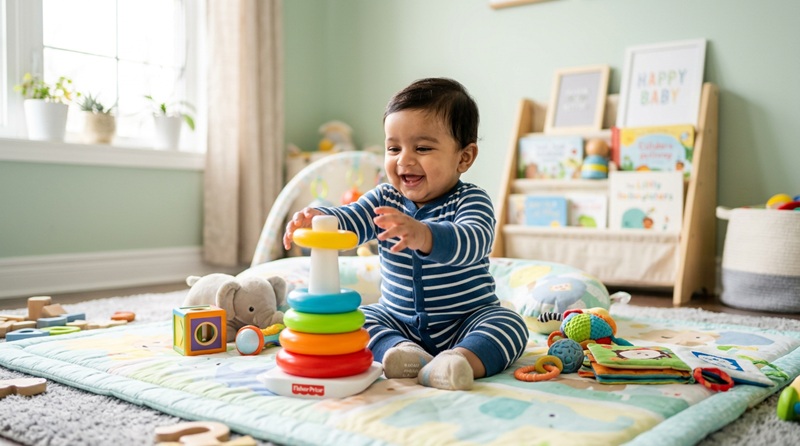
Tracking your baby milestones during the first year is one of the most rewarding parts of parenthood.
Key Takeaways
- From the moment you hold your baby in your hands, parenthood is a journey like no other.
- Here are some important milestones you can expect in your baby’s first year:.
Precious First Year of Milestones to Look Forward to
From the moment you hold your baby in your hands, parenthood is a journey like no other. And like any journey, parenthood has its fill of roadblocks, smooth sailings, dead ends, and… milestones! These are the milestones your baby will mark in its first year of birth.
Also read: Surprising Benefits of Baby Massage.
In just a span of 12 short months, your baby goes from a completely dependent newborn to an active toddler. Being a crucial year for your baby’s development, these milestones can also help you identify whether or not everything is well with your baby.
Rather than boring you with a newborn development week by week chart, let’s measure these milestones by solid steps. However, baby growth stages have fairly wide windows so, it’s important to remember that your baby might hit some milestones earlier than expected, and some later.
Now let’s get to learning more about these first-year milestones!
- Your baby’s first smile
After almost two months of sleepless nights and endless soothing, you’ve probably had enough of your baby’s tears. So, now it’s time for the reward! At around 2 months of age, your little one smiles a toothless, all-gums smile at you! Often, the sound of your voice or the sight of your face is all it takes to trigger your baby’s smile.
- Smiles to laughs
By 4-6 months of age, you can look forward to another sound that’ll tug at your heart strings forever – your baby’s laughter. The best part is – you’ll get an abundance of their laughter during these months. Goofy faces, cuddles and tickles, peek-a-boo’s, anything can set off their coos and giggles for you.
- A full night of sleep
Nothing will bring you more relief than what this milestone brings for you as well. Rejoice! By 4-6 months of age, your baby will finally sleep through the night just like you. Have your baby wear Teddyy Baby Diapers so they don’t have to wake up in the middle of the night due to wet diapers.
- Sitting up straight
Around 5 or 6 months of age, most babies will sit up straight with support – either by resting on some pillows or walls, or by leaning on their hands in front of them. They will sit up steadily without support by 7-9 months.
- Crawling around
Time for exercise! Around 9 months, your baby finally learns to crawl on all fours and you will spend all your time chasing and finding your baby around the house in different nooks and crannies. On the other hand, some babies never learn to crawl as they prefer creeping or wriggling to crawling. Nothing to worry though, they will hit the other milestones just fine.
- Nos and bye-byes
By 9 months, most babies will start to make connections between sounds, gestures, and their meanings. Headshakes and waving hands are not just a cute trick anymore. They will understand that waving hands is connected to the phrase ‘bye-bye’ and shaking their head means disagreeing.
- Finger food time
Spoon-feeding doesn’t have the appeal it used to have anymore for your baby, now they’re ready to explore. By the age of 9-12 months, your baby would love to explore the taste, smell, and texture of food. They also gain better control over their hands and fingers, making it easier for them to pick up food and finger-feed themselves. However, food is not the only thing they’ll pick up and taste, they’ll pop anything and everything into their mouth if they can get their hands on it.
- First stand
By 12 months, most babies will begin to stand briefly without support. They also take small steps holding onto furniture and other objects. This activity is called ‘cruising’, and they will spend hours cruising each day for weeks or months to practice for the real deal.
- First step
You might as well call it the best milestone of the first year. Perhaps no other milestone will be met with more camera clicks than this one. All those cruising pays off and your baby takes their first independent step. The average range for this milestone is between 9-17 months, so don’t be concerned if your baby takes too long to walk.
- First word
We’re sorry, forget first steps, THIS milestone is clearly a cut above everything that preceded! Nothing like hearing your baby call you ‘mama’ or ‘dada’, and it happens right around the one-year mark. They will also actively try to imitate other words and converse in baby gibberish with you, hold these conversations, guess what they’re trying to say to you.
Wow, your baby’s first birthday comes with so many exciting surprises for you! That said, remember that these milestones have wide windows. Just focus on the development of your little one instead of comparing them to guides you found on the internet or other babies. It’s not a race, it doesn’t have a deadline. Nobody’s going to ask for their college applications once they walk or say ‘mama’. Live in the present, and don’t miss your baby’s picture-worthy milestones to needless worrying.
What are normal milestones for babies
Here are some important milestones you can expect in your baby’s first year:
- Smiling and laughing
- Sitting up and crawling
- Sitting up straight
- Taking their first step
Uttering their first ‘mama’ or ‘dada’