
Fetal Weight Chart in Grams and Kg: A Complete Week-by-Week Guide
By Teddyy Editorial Team | Last Updated: April 3, 2026
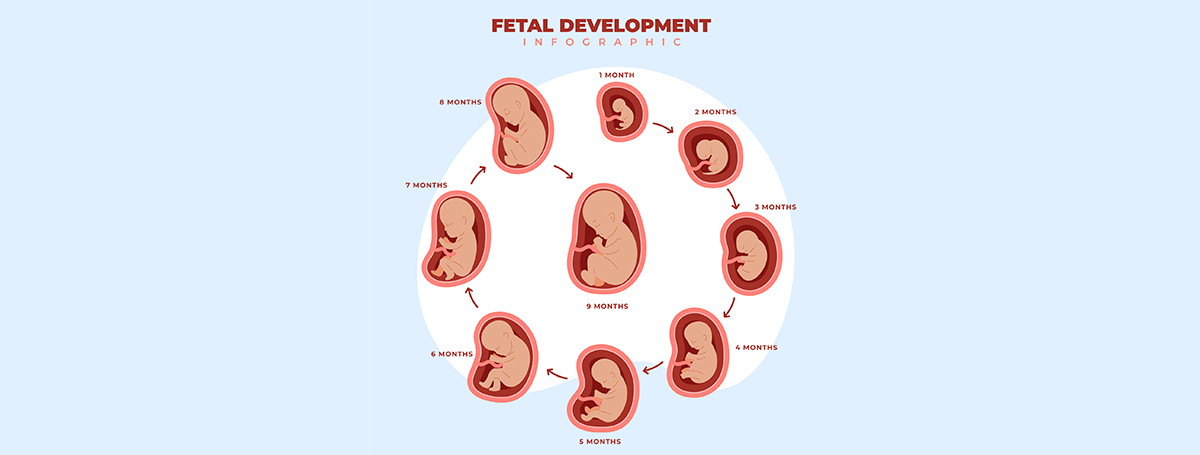
Tracking your baby’s weight during pregnancy is one of the most reliable ways to check that growth is on track. Doctors use ultrasound measurements and established growth charts to estimate how much your baby weighs at each stage. This guide covers what those numbers mean, what the expected weight ranges are from week 8 through week 41, what factors affect growth, and when to talk to your doctor.
✅ The unified chart below shows expected weight in both grams and kilograms for every week of pregnancy.
✅ Genetics, maternal nutrition, placental health, and medical conditions all influence how fast your baby grows.
✅ Weight outside the normal range does not always mean a problem, but it should be discussed with your doctor.
How Is Fetal Weight Measured
Your doctor estimates your baby’s weight using ultrasound measurements. The key measurements include head circumference (HC), abdominal circumference (AC), and femur length (FL). These are plugged into a formula (most commonly the Hadlock formula) that calculates an estimated fetal weight (EFW).
It is important to understand that EFW is an estimate, not an exact number. Ultrasound weight estimates can be off by 10-15% in either direction. So if your baby’s estimated weight is slightly above or below the chart values, it does not necessarily mean something is wrong.
Fetal Development Stages

First Trimester (Weeks 1-12)
During the first 12 weeks, your baby goes from a single cell to a fully formed miniature human with all major organs in place. Growth in weight is slow at this stage. By the end of week 12, your baby weighs roughly 14 grams and measures about 6 cm.
Second Trimester (Weeks 13-26)
This is the period of rapid weight gain. Bones harden, muscles develop, and fat begins to accumulate. By week 20, your baby weighs around 300 grams. By week 26, weight reaches approximately 760 grams.
Third Trimester (Weeks 27-40)
The final stretch is all about weight gain. Your baby adds about 200-250 grams per week during this period. Lungs mature, the brain develops rapidly, and fat stores build up for temperature regulation after birth. By week 40, the average baby weighs about 3.4 kg.
Factors That Influence Baby’s Growth
Several factors determine how fast your baby grows:
Genetics
Parental height and build are strong predictors. Taller parents tend to have larger babies. Ethnic background also plays a role in average birth weight.
Maternal Nutrition
A balanced diet with adequate protein, iron, calcium, and folic acid supports healthy growth. Severe nutritional deficiencies can lead to lower birth weight.
Placental Health
The placenta delivers oxygen and nutrients to your baby. Conditions like placental insufficiency can restrict nutrient flow and slow growth.
Medical Conditions
Gestational diabetes can lead to larger babies (macrosomia), while high blood pressure or preeclampsia can restrict growth. Multiple pregnancies (twins, triplets) also typically result in lower individual birth weights.
Fetal Weight Chart: Week-by-Week (Grams and Kg)
The table below shows the average estimated weight at each week of pregnancy. These values are based on the Hadlock growth formula and WHO fetal growth standards. Individual babies may weigh more or less than these averages.
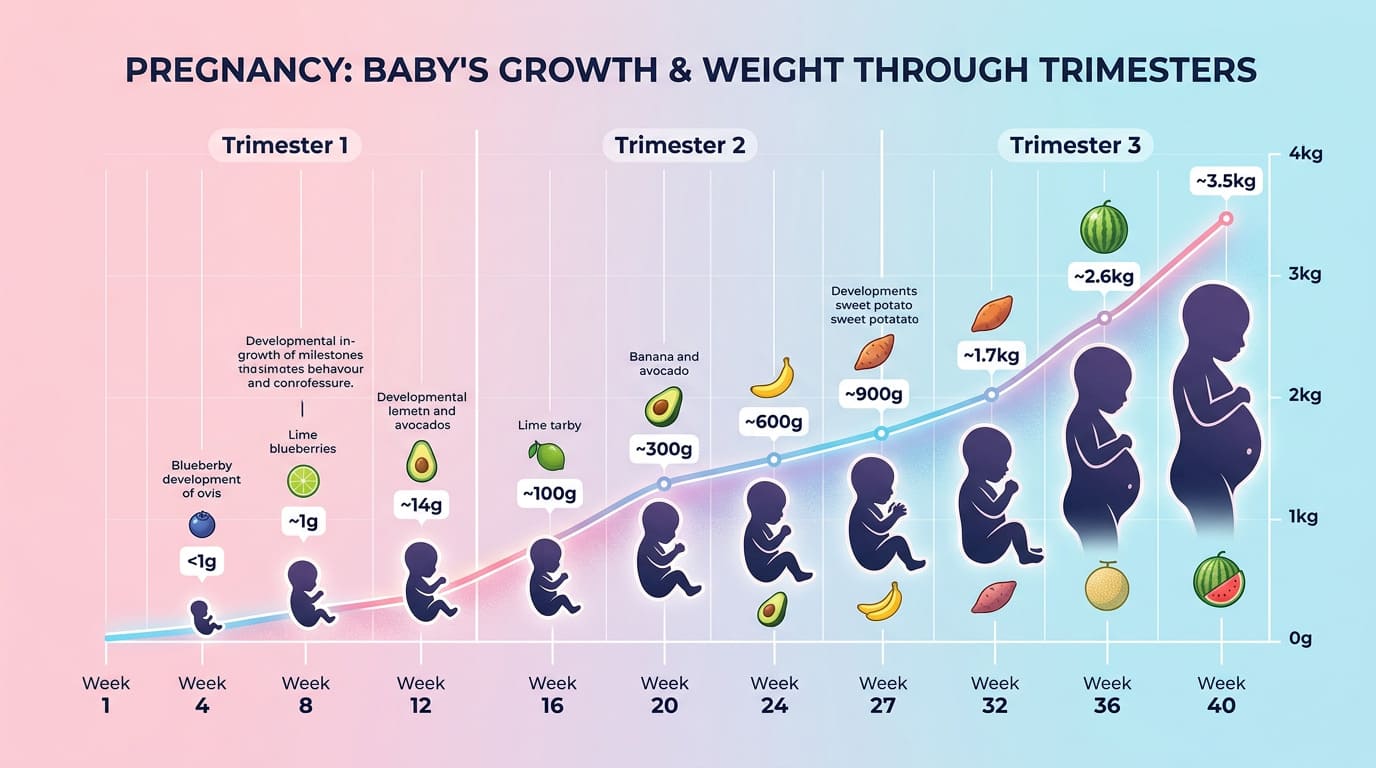
| Week | Weight (Grams) | Weight (Kg) |
|---|---|---|
| 8 | 1 g | 0.001 kg |
| 9 | 2 g | 0.002 kg |
| 10 | 4 g | 0.004 kg |
| 11 | 7 g | 0.007 kg |
| 12 | 14 g | 0.014 kg |
| 13 | 23 g | 0.023 kg |
| 14 | 43 g | 0.043 kg |
| 15 | 70 g | 0.070 kg |
| 16 | 100 g | 0.100 kg |
| 17 | 140 g | 0.140 kg |
| 18 | 190 g | 0.190 kg |
| 19 | 240 g | 0.240 kg |
| 20 | 300 g | 0.300 kg |
| 21 | 360 g | 0.360 kg |
| 22 | 430 g | 0.430 kg |
| 23 | 501 g | 0.501 kg |
| 24 | 600 g | 0.600 kg |
| 25 | 660 g | 0.660 kg |
| 26 | 760 g | 0.760 kg |
| 27 | 875 g | 0.875 kg |
| 28 | 1005 g | 1.005 kg |
| 29 | 1153 g | 1.153 kg |
| 30 | 1319 g | 1.319 kg |
| 31 | 1502 g | 1.502 kg |
| 32 | 1702 g | 1.702 kg |
| 33 | 1918 g | 1.918 kg |
| 34 | 2146 g | 2.146 kg |
| 35 | 2383 g | 2.383 kg |
| 36 | 2622 g | 2.622 kg |
| 37 | 2859 g | 2.859 kg |
| 38 | 3083 g | 3.083 kg |
| 39 | 3288 g | 3.288 kg |
| 40 | 3462 g | 3.462 kg |
| 41 | 3597 g | 3.597 kg |
Note: These are 50th percentile estimates. A healthy baby can weigh 15-20% above or below these values. Your doctor will track your baby’s growth trend over multiple visits rather than comparing a single reading to the chart.
When Baby’s Weight Is Outside the Normal Range
Not every baby follows the chart exactly, and that is normal. However, your doctor will pay close attention if the estimated weight falls below the 10th percentile or above the 90th percentile for gestational age.
Low Estimated Weight (Small for Gestational Age)
When a baby measures significantly smaller than expected, it may indicate fetal growth restriction (FGR). Common causes include placental problems, maternal high blood pressure, infections, smoking, or alcohol use during pregnancy. FGR increases the risk of preterm birth and low birth weight. Your doctor may recommend more frequent ultrasounds to monitor growth, and in some cases, early delivery may be necessary.
High Estimated Weight (Large for Gestational Age)
A baby that measures significantly larger than expected is called macrosomic (typically above 4 kg at birth). The most common cause is gestational diabetes, which allows excess glucose to cross the placenta and accelerate growth. Macrosomia increases the risk of delivery complications, birth injuries, and the need for a caesarean section. Managing blood sugar levels through diet, exercise, and medication (if prescribed) helps control excess growth.
Tips for Supporting Healthy Growth
Eat a Balanced Diet
Focus on protein-rich foods (eggs, lentils, fish, lean meat), iron-rich vegetables, whole grains, and dairy for calcium. Folic acid is critical in the first trimester for neural tube development.
Stay Active
Regular moderate exercise like walking, swimming, or prenatal yoga improves blood circulation to the placenta and supports healthy growth. ACOG recommends at least 150 minutes of moderate activity per week during pregnancy.
Attend All Prenatal Appointments
Regular check-ups allow your doctor to track growth trends over time. A single measurement that looks unusual is less important than the overall pattern across multiple visits.
Avoid Harmful Substances
Smoking, alcohol, and recreational drugs directly affect placental function and can restrict your baby’s growth. If you need help quitting, talk to your doctor.
Manage Existing Health Conditions
If you have diabetes, hypertension, or thyroid disorders, work closely with your doctor to keep these conditions well-controlled throughout pregnancy.
Conclusion
Tracking your baby’s weight is a useful tool for monitoring healthy development, but it is just one piece of the picture. Every baby grows at their own pace, and small variations from the chart are common and usually not a concern. The most important thing is to attend your prenatal appointments regularly, eat well, stay active, and communicate openly with your doctor about any concerns.
References
- ACOG. “How Your Fetus Grows During Pregnancy.” American College of Obstetricians and Gynecologists. 2023.
- WHO. “Fetal Growth Charts.” World Health Organization Multicentre Growth Reference Study. 2023.
- Hadlock FP, et al. “Estimation of fetal weight with the use of head, body, and femur measurements.” American Journal of Obstetrics and Gynecology. 1985;151(3):333-337.
- Papageorghiou AT, et al. “International standards for fetal growth (INTERGROWTH-21st).” The Lancet. 2014;384(9946):869-879.
- FOGSI. “Good Clinical Practice Recommendations on Fetal Growth Monitoring.” Federation of Obstetric and Gynaecological Societies of India. 2021.
You May Also Like




Faq's
1. What is a fetal weight chart and how do I read it week by week?
A fetal weight chart lists typical estimated fetal weights (EFW) for each gestational week so you can compare your baby’s scan results with age-based averages.
2. What is the normal fetal weight at 20, 28, 32, and 36 weeks (in kg & grams)?
Approximate averages: 20w ~300 g (0.3 kg), 28w ~1,000 g (1 kg), 32w ~1,700–1,800 g (1.7–1.8 kg), 36w ~2,600–2,800 g (2.6–2.8 kg). Individual growth varies—use your scan’s percentile for context.
3. How accurate is ultrasound estimated fetal weight (EFW)?
EFW is an estimate with a typical ±10–15% margin of error, especially closer to your due date; your provider interprets it in context.
4. What do fetal weight percentiles mean (10th, 50th, 90th)?
Percentiles compare your baby’s EFW with peers the same gestational age: 50th ≈ average, <10th = smaller than most, >90th = larger than most.
5. What if my baby’s weight is below the 10th percentile (SGA)?
It may indicate small for gestational age; doctors usually recommend closer monitoring (repeat scans, Doppler, nutrition guidance) and a personalized care plan.
6. Do fetal weight charts differ for twins?
Yes. Twins often follow slightly different growth curves, particularly in the third trimester; clinicians use twin-specific references and track any weight discordance.