
Month by Month Baby Care Guide: Milestones, Feeding, Sleep & Expert Tips
A complete roadmap for your baby's first year — from first coos to first steps.
The first twelve months of your baby's life are extraordinary. Every week brings something new — a smile that wasn't there yesterday, fingers that suddenly grip yours tighter, a babble that sounds almost like a word. It's beautiful, exhausting, and sometimes confusing all at once.
This baby care guide walks you through every month of your baby's first year, covering the milestones, feeding changes, sleep patterns, vaccination schedules, and everyday care tips that matter most. Each month's guide is written with Indian parents in mind — covering everything from India's national immunization schedule to age-appropriate Indian foods when it's time to start solids.
Whether you're a first-time parent figuring things out or going through it again with a second child, this guide is designed to give you clear, reliable answers when you need them most — at 2 AM, between feeds, or right before a doctor's appointment.
Jump to Your Baby's Month
- Month 1 — First Smiles & Finding a Rhythm
- Month 2 — Social Smiles & Better Sleep Stretches
- Month 3 — Stronger Neck, Louder Laughs
- Month 4 — Rolling Over & the 4-Month Sleep Shift
- Month 5 — Sitting with Support & Early Teething
- Month 6 — Starting Solids & Sitting Up
- Month 7 — Crawling Prep & Babbling
- Month 8 — Separation Anxiety & Finger Foods
- Month 9 — Standing, Cruising & Growing Independence
- Month 10 — First Words & Fine Motor Skills
- Month 11 — Walking Practice & Personality Emerging
- Month 12 — Happy First Birthday!
Your Baby's First Year: Month by Month
First Smiles & Finding a Rhythm
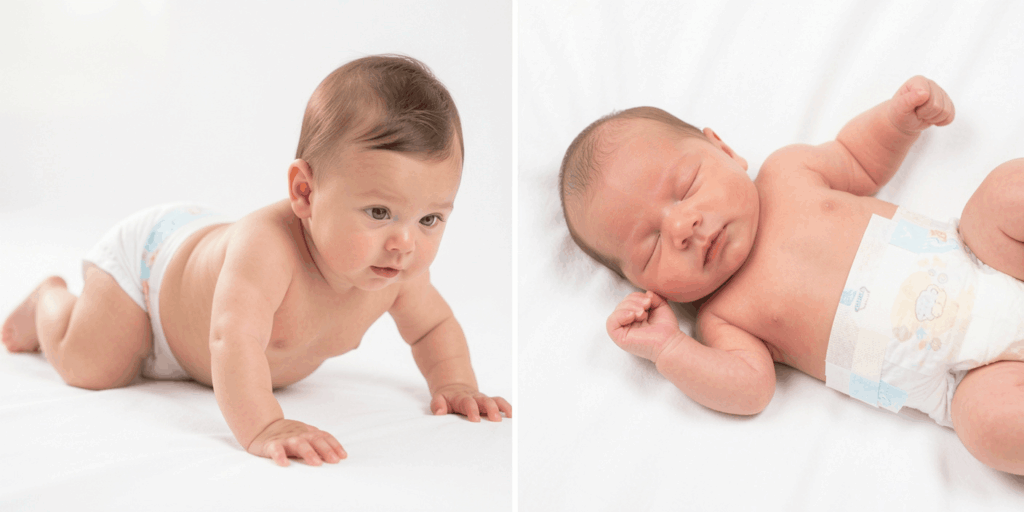
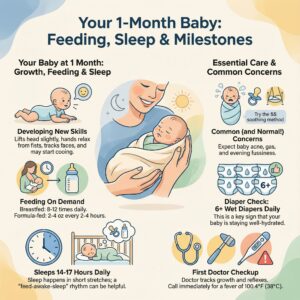
Everything feels new — for you and your baby. In the first month, your newborn is adjusting to life outside the womb while you're learning to read their cues. Expect lots of feeding sessions (8-12 times a day for breastfed babies), short sleep stretches, and those heart-melting moments when they curl their tiny fingers around yours.
- Head lifts during tummy time
- Responding to familiar voices
- 14-17 hours of sleep in short bursts
- Umbilical cord care essentials
Social Smiles & Better Sleep Stretches
This is when things start to feel just a little more predictable. Your baby's first real social smile usually appears around 6-8 weeks, and it's absolutely worth the sleepless nights. Feeding patterns become slightly more regular, and some babies start sleeping longer stretches at night — though every baby has their own timeline.
- First real social smiles
- Tracking objects with eyes
- Cooing and gurgling sounds
- First round of vaccinations (6-8 weeks)
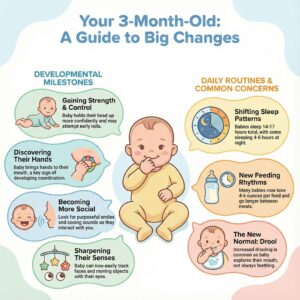
Stronger Neck, Louder Laughs
By three months, your baby's neck muscles are getting noticeably stronger. They can hold their head up during tummy time and might even push up on their arms. The biggest reward this month? That first laugh. Expect more vocal experiments — squeals, coos, and attempts at "conversation" when you talk to them.
- Steadier head control
- First laughs and squeals
- Hands open more, grasping at objects
- Beginning to recognise faces
Rolling Over & the 4-Month Sleep Shift
Month four is packed with visible progress. Many babies start rolling from tummy to back, reaching for toys, and showing real personality. But here's the thing parents don't always expect — the 4-month sleep regression. Your baby's sleep cycles are maturing, which temporarily disrupts the longer stretches you may have just gotten used to.
- Rolling tummy to back
- Improved hand-eye coordination
- 4-month sleep regression
- Doubled birth weight for many babies
Sitting with Support & Early Teething Signs
Your baby is getting physically stronger and more curious about everything around them. Sitting with support, reaching for objects deliberately, and putting everything in their mouth — that last part might mean early teething is starting. Watch for drooling, gum rubbing, and extra fussiness as those first teeth begin to push through.
- Sitting with support
- Teething signs appearing
- Mouthing everything
- Recognising their own name
Starting Solids & Sitting Independently
This is a landmark month. Most paediatricians recommend introducing solid foods around six months while continuing breastfeeding. Your baby can likely sit without support now and is showing clear interest in what you're eating. In India, common first foods include dal water, mashed banana, rice cereal, and ragi porridge.
- Introduction to solid foods
- Sitting independently
- Babbling consonant sounds (ba, da, ma)
- 6-month vaccination boosters
Crawling Prep & Babbling Conversations
Seven months brings a burst of physical energy. Your baby might be rocking on hands and knees, scooting backwards, or already army-crawling across the room. Babbling is getting more complex — you'll hear strings of sounds that almost feel like real words. This is also when separation anxiety may start making an appearance.
- Rocking on hands and knees
- More complex babbling
- Early separation anxiety
- Expanding food textures
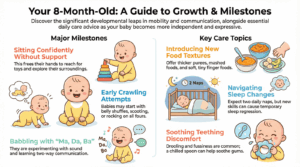
Separation Anxiety & Finger Foods
By eight months, your baby has a clear preference for you — which is wonderful, but it also means separation anxiety can peak. They may cry when you leave the room. On the brighter side, those fine motor skills are developing fast. Finger foods become a real option now — small, soft pieces they can pick up using a pincer grasp.
- Peak separation anxiety
- Pincer grasp developing
- Pulling to stand
- Responding to "no"
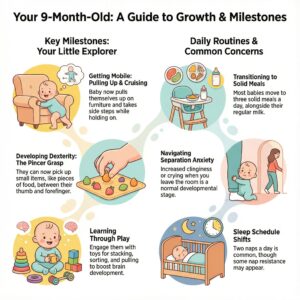
Standing, Cruising & Growing Independence
Your baby is on the move. Pulling to stand using furniture, cruising along edges, maybe even standing unassisted for a few seconds. Their understanding of language is also leaping forward — they follow simple instructions, point at things they want, and might wave bye-bye. The 9-month checkup is an important one for tracking developmental progress.
- Pulling to stand and cruising
- Understanding simple words
- Pointing and waving
- 9-month developmental checkup
First Words & Fine Motor Leaps
Those babbles are starting to sound intentional. "Mama" and "dada" used in context often appear around month 10. Your baby is also getting better at manipulating objects — stacking, dropping, picking up small things with precision. It's a great time to introduce simple cause-and-effect toys and let them explore textures during mealtime.
- First intentional words
- Improved fine motor control
- Standing more confidently
- Feeding themselves with fingers
Walking Practice & Personality Shining Through
Eleven months in, and your baby's personality is unmistakable. They have preferences, opinions, and a growing sense of humour. Physically, some babies take their first independent steps this month, though anywhere between 9 and 15 months is completely normal. Their diet is expanding to include most family foods in smaller, softer portions.
- First steps for some babies
- Strong personality and preferences
- Following multi-step requests
- Transitioning toward family meals
Happy First Birthday!
What a year it's been. Your baby has tripled their birth weight, gone from barely lifting their head to possibly walking across the room, and learned to communicate in ways that surprise you daily. The 12-month mark also brings important vaccinations and a developmental checkup. Take a moment to celebrate — not just your baby's milestones, but yours as a parent.
- Walking independently (for many babies)
- Speaking 1-3 words with meaning
- 12-month vaccinations
- Transition to whole milk and family foods
Baby Milestones at a Glance: Birth to 12 Months
Every baby develops at their own pace, so treat this chart as a general guide rather than a strict checklist. If you have concerns about your baby's development, your paediatrician is always the best person to ask.
| Month | Physical Milestones | Feeding | Sleep (24 hrs) |
|---|---|---|---|
| 1 | Head lifts, fist grip, tracks faces | Breast/formula only, 8-12 feeds/day | 14-17 hours |
| 2 | Social smile, smoother movements | Breast/formula, slightly longer gaps | 14-17 hours |
| 3 | Steady head control, first laughs | Breast/formula, 5-6 feeds/day | 14-16 hours |
| 4 | Rolling over, reaching for objects | Breast/formula, may show food interest | 12-16 hours |
| 5 | Sitting with support, early teething | Breast/formula, teething may affect feeding | 12-15 hours |
| 6 | Sitting alone, babbling consonants | Solids introduced + breast/formula | 12-15 hours |
| 7 | Rocking on all fours, army crawling | Expanding textures and flavours | 12-14 hours |
| 8 | Crawling, pulling to stand | Finger foods, pincer grasp | 12-14 hours |
| 9 | Cruising along furniture, pointing | 3 meals + snacks + breast/formula | 12-14 hours |
| 10 | Standing confidently, first words | Self-feeding improving | 11-14 hours |
| 11 | First steps (some babies), strong grip | Most family foods in smaller portions | 11-14 hours |
| 12 | Walking, 1-3 intentional words | Transition to whole milk + family meals | 11-14 hours |
India Vaccination Schedule: Key Dates in Baby's First Year
India's Universal Immunization Programme covers essential vaccines free of cost at government health centres. Here are the key vaccination windows to keep on your radar during the first 12 months:
| Age | Vaccines |
|---|---|
| At birth | BCG, OPV-0 (Oral Polio), Hepatitis B — Birth dose |
| 6 weeks | OPV-1, Pentavalent-1 (DPT + HepB + Hib), Rotavirus-1, fIPV-1, PCV-1 |
| 10 weeks | OPV-2, Pentavalent-2, Rotavirus-2 |
| 14 weeks | OPV-3, Pentavalent-3, Rotavirus-3, fIPV-2, PCV-2 |
| 6 months | Influenza (optional, recommended by IAP) |
| 9 months | MR-1 (Measles-Rubella), PCV Booster, JE-1 (in endemic areas) |
| 12 months | Hepatitis A-1 (optional, IAP recommended) |
Always confirm the exact schedule with your paediatrician. Optional vaccines recommended by the Indian Academy of Pediatrics (IAP) may involve additional costs at private clinics.
Essential Baby Care Topics Every Parent Should Know
Feeding Your Baby: From Birth to First Birthday
The feeding journey changes dramatically over 12 months. Exclusive breastfeeding (or formula) for the first six months is recommended by the WHO and IAP. After that, it's a gradual introduction to solids while continuing milk feeds. By 12 months, your baby should be eating a variety of family foods. Our newborn feeding chart breaks down exactly how much and how often at each stage.
Sleep Patterns: What's Normal and When It Changes
Newborns sleep 14-17 hours but in 2-4 hour stretches. By 4 months, sleep cycles mature (hello, sleep regression). By 6 months, many babies can do 6-8 hour stretches at night. And by 12 months, most have settled into a pattern of 11-14 hours with 1-2 naps. Read our safe sleep guide for evidence-based tips on creating a secure sleep environment.
Diapering Done Right
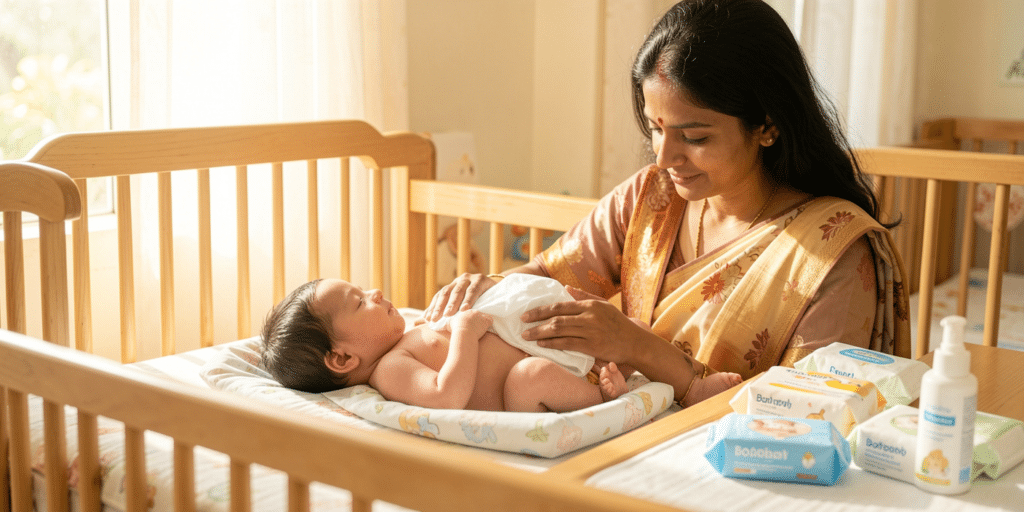
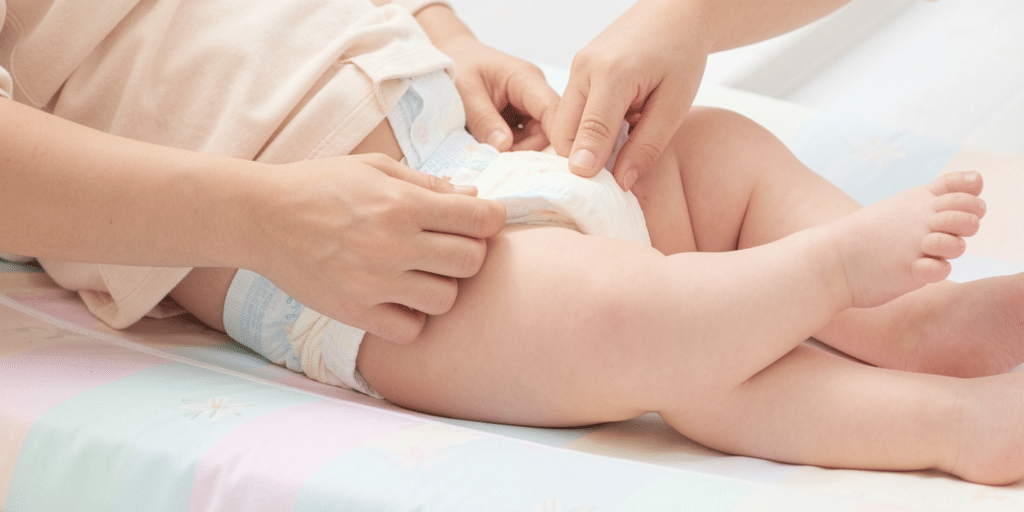
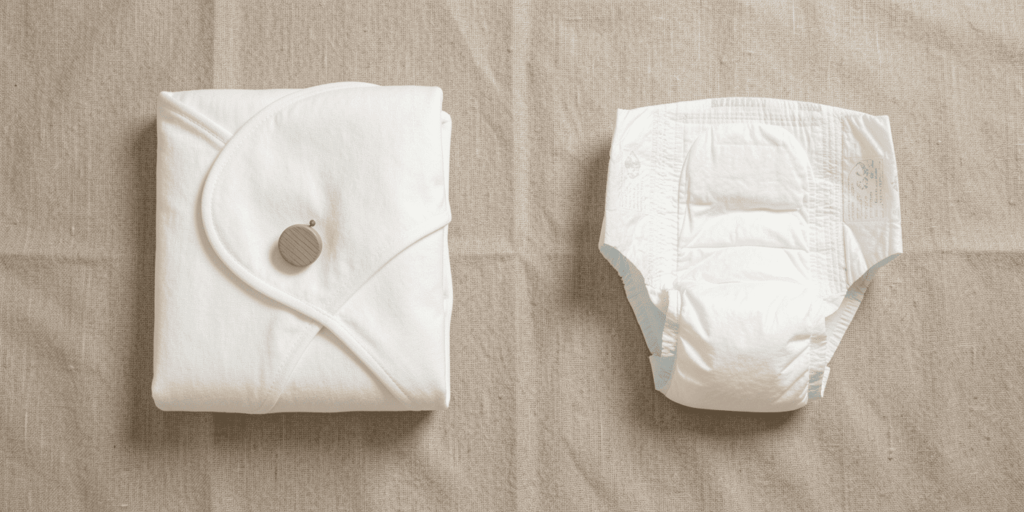
You'll change roughly 2,500 diapers in the first year. Choosing the right diaper matters — not just for leak protection, but for your baby's skin health. A well-designed diaper keeps moisture away from sensitive skin and reduces the risk of diaper rash. As your baby grows, they'll move through sizes — from Newborn to Small to Medium and eventually Large. Our diaper size finder helps you pick the right fit at every stage.
When to Call the Doctor
Trust your instincts. If something feels off, it's always worth a call. That said, these signs need immediate attention at any age: fever above 100.4°F (38°C) in newborns, difficulty breathing, refusal to feed for extended periods, unusual lethargy, or a rash that doesn't fade when pressed. Your baby's regular checkups at 1, 2, 4, 6, 9, and 12 months are your best opportunity to raise questions and track development.
Frequently Asked Questions
1. When should I start tummy time with my baby?
You can start tummy time from day one — even on day one home from the hospital. Begin with 2-3 minutes at a time, a few times a day. By 3 months, aim for a total of 30-60 minutes spread throughout the day. Tummy time builds the neck, shoulder, and core strength your baby needs for rolling, sitting, and eventually crawling.
2. What is the right age to introduce solid foods to my baby?
Both the WHO and the Indian Academy of Pediatrics recommend exclusive breastfeeding for the first 6 months, followed by the gradual introduction of complementary solid foods alongside continued breastfeeding. Signs your baby is ready include sitting with support, showing interest in food, and being able to move food from a spoon to the back of their mouth.
3. How do I know if my baby is developing normally?
Every baby develops at their own pace. The milestones listed in each month's guide are general ranges, not strict deadlines. That said, your paediatrician will track key markers at each checkup. If your baby hasn't reached a milestone well past the typical window, or if you notice a regression (losing skills they had before), bring it up with your doctor.
4. How often should I change my baby's diaper?
Newborns need a diaper change every 2-3 hours, or roughly 8-12 times a day. As your baby grows, this drops to about 6-8 changes. Always change immediately after a bowel movement to prevent diaper rash. Using a high-quality diaper that locks moisture away from the skin — like Teddyy Diapers — helps keep your baby comfortable between changes.
5. What vaccines does my baby need in the first year in India?
India's Universal Immunization Programme covers vaccines at birth, 6 weeks, 10 weeks, 14 weeks, 9 months, and 12 months. Key vaccines include BCG, Polio (OPV/IPV), Pentavalent (DPT + HepB + Hib), Rotavirus, PCV, and Measles-Rubella. The Indian Academy of Pediatrics also recommends optional vaccines like Influenza and Hepatitis A. Refer to the vaccination table above or consult your paediatrician for the full schedule.
6. How can I tell if my baby is getting enough milk?
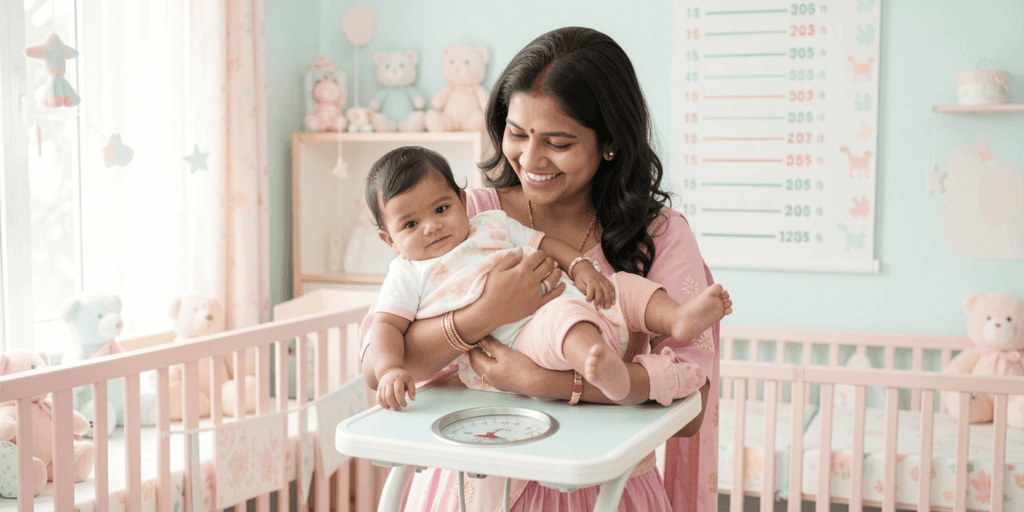
The best indicators are weight gain and diaper output. A well-fed newborn should have 6 or more wet diapers and 3-4 dirty diapers a day. Steady weight gain along their growth curve is the most reliable sign. If your baby seems satisfied after feeds, is alert during wake times, and is meeting developmental milestones, they're likely getting exactly what they need.
7. What should I do about the 4-month sleep regression?
The 4-month sleep regression happens because your baby's sleep cycles are maturing — it's actually a sign of brain development. It typically lasts 2-4 weeks. During this time, maintain a consistent bedtime routine, keep the sleep environment dark and calm, and respond to your baby without creating new sleep associations you'll need to undo later. It passes.
8. Is it normal for my baby to not crawl?
Yes. Not all babies crawl in the traditional hands-and-knees way. Some army crawl, some scoot on their bottom, and some skip crawling entirely and go straight to pulling up and walking. As long as your baby is finding ways to move and explore their environment, the exact method matters less than the progress.
More from the Teddyy Baby Care Library
- Pregnancy Guide: Week by Week — Track your pregnancy journey before baby arrives
- Baby Milestones: Your Child's First Year of Development
- Newborn Baby Feeding Chart: How Often Should I Feed My Baby?
- Breast Milk Storage Guide: Safe Practices for New Moms
- Safe Sleep for Babies: A Complete Guide
- How to Teach Your Baby to Walk: Step-by-Step Guide
- Potty Training Made Easy: Right Age, Signs & Proven Tips
- Decoding Baby Lingo: What Is Your Baby Trying to Tell You?